
- Commissioner’s statement on Ventura, Marte
- Ronnie O’Sullivan: Masters champion ‘felt so vulnerable’ in final
- Arron Fletcher Wins 2017 WSOP International Circuit Marrakech Main Event ($140,224)
- Smith challenges Warner to go big in India
- Moncada No. 1 on MLB Pipeline’s Top 10 2B Prospects list
- Braves land 2 on MLB Pipeline’s Top 10 2B Prospects list
- Kingery makes MLB Pipeline’s Top 10 2B Prospects list
- New Zealand wrap up 2-0 after Bangladesh implosion
- Mathews, Pradeep, Gunathilaka to return to Sri Lanka
- Elliott hopes for rain for Poli
IOC: No Blanket Ban On Russia & Abdicates Duty But Efimova*, Lovtcova** Et Al: Gone
- Updated: July 24, 2016
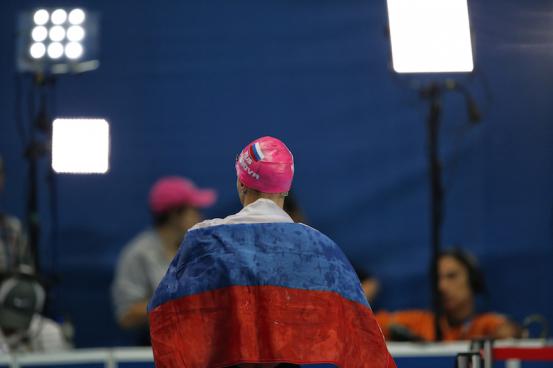
The International Olympic Committee has failed to impose a blanket ban on Russia and has abdicated its duty by handing the decision on whether the country’s athletes can compete at the Rio 2016 Olympic Games to international federations such as FINA. However, in the midst of the detail is a ban on all Russians who were ever sanctioned for doping: Yuliya Efimova, the World 100m breaststroke champion, is gone.
Instant reports as the IOC meets the media in Lausanne is that “The IOC will not accept any entry of any Russian athlete unless they meet certain criteria”. Russians will race in Rio. How many and in which sports remains to be seen. Russian sports federations and their respective international bodies will now find any way possible to get their athletes into competition in Rio.
“Specific criteria” includes proving that they have not tested positive in international tests – as opposed to Russian tests. That compromise places emphasis on the athletes are takes focus away from the role of the Russian state. The IOC also rejected the notion of whistleblower Yuliya Stepanova racing under a neutral flag.
Telling the truth is not rewarded; dragging the Olympic Movement through the mud with cheating and corruption is tolerate.
The IOC decision in full at the foot of this file
That includes the following critical and great news for swimming:
Article 3 states:
“The ROC is not allowdd to enter any athlete for the Olympic games Rio 2016 who has ever been sanctioned for doping, even if he he or she had served the sanction.”
The following list of Russian aquatic athlete will no longer be able to race in Rio:
Yuliya Efimova by Patrick B. Kraemer
2016 – Meldonium cases may not count, pending research into the substance by WADA. Yuliya Efimova (see 2013) and Grigory Tarasevich 2015 Yana Martynova – as above – banned for four year 2014 National Federation Case: Vladimir Dyatchin – Ostarine (Class S.1.2 Other Anabolic Agents) following a doping control test conducted with the occasion of the Russian Open Water Championships – 2 years suspension from July 4, 2014 National Federation Case: Olga Kluchnikova – Acetazolamide (Class S.5 Diuretics and Masking Agents) Russian National Swimming Championships May 14 [Term: 27-May-14 – 26-Nov-14] 2013 FINA Case: Vitaly Melnikov (RUS) – Erythropoietin – EPO (Class S.2 Peptides Hormones, Growth Factors and related Substances) at the LEN European Swimming Championships held in Herning (DEN). Two years’ suspension – cancellation of results (forfeiture of medals/prizes, reimbursement of prize money). FINA Case: Yuliya Efimova – DC 2.1 – 7-keto DHEA OOCT California out of competition test, October 13 [Term: 31-Oct-13 – 28-Feb-14] FINA Case: Sergey Makov – DC 2.1 – Ostarine FINA Swimming World Cup in Moscow, October 13 [Term: 12-Oct-13 – 12-Oct 15] National Federation Case: Nikita Maksimov – DC 2.1 – Oral Turinabol Russia out of competition, March 13 [Term: 4-Apr-13 – 4-Apr-15] National Federation Case: Igor Akhlustin – DC 2.1 – Methylhexaneamine Russian National Swimming Championships, June 13 [Term: 3-Jul-13 – 3-Jul-15] National Federation Case: Anton Komlev – DC 2.1 – Fenoterol Russian Junior Swimming Championships, June 13 [Term: 3-Jul-13 – 3-Jul-14] National Federation Case: Victoria Mukhametova – DC 2.1 – Bromantan Russian Swimming Cup, April 13 [Term: 30-Apr-13 – 30-Apr-14] National Federation Case: Anastasia Krapivina – DC 2.1 – Methylhexaneamine Russian Swimming Cup, April 13 [Terms: 30-Apr-13 – 30-Sep-13] National Federation Case: Mikhail Dovgaluk – DC 2.1 – Methylhexaneamine Russian Junior Swimming Championships, June 13 [Term: 3-Jul-13 – 3-Jul-14] 2012 National Federation Case: Natalia Lovtsova – DC 2.1 – Methylhexaneamine Russian National Swimming Championships, November 12 [Term: 30-Nov-12 – 30-May-15] National Federation Case: Ekaterina Andreeva – DC 2.1 – Methylhexaneamine Russian National Swimming Championships, November 12 [Term: 30-Nov-12 – 30-May-14] National Federation Case: Kseniya Moskvina – did not make herself available for testing Russian National Swimming Championships, November 12 [Term: 25-Nov-12 – 25-Nov-13] National Federation Case: Kseniya Moskvina DC 2.1 – Methylhexaneamine Russian National Swimming Championships, November 12 [Term: 26-Nov-13 – 26-Nov-19] 6 years – second offence National Federation Case: Daria K. Ustinova – DC 2.1 – Tuaminoheptane Russian National Swimming Championships November 12 [Warning, owing to age – 14] 2011 National Federation Case: Alexander Bodyakin – Furosemide Out of competition March 11 [Term: 21-Mar-11 – 21-Sep-11] 2010 FINA Case: Maxim Shcherbakov – 3 filing failures (availability) Out of competition, 05-Nov-10 [Term 1 year, 05-Nov-10 – 5-Nov-11] FINA Case: Evgeny Aleshin – 3 filing failures (availability) Out of competition, 05-Nov-10 [Term 2 years] 2009 FINA Case: Alexander Morgunov – Norandrosterone, Noretiocholanolone – two years to June 5, 2011 National Federation Case: Ksenia Ivliva – Furosemide – 2 years National Federations Case: Nikita Leviakov – Stanazolol & dehydrochlromethylestosterone – a the junior nationals – 2 years
The questions on several levels will now flow: has Russia manipulated the IOC and its system? Meanwhile, the entertainment value of Rio 2016 in some sports looks set to be damaged.
The decision “reeks of the fact that the IOC is under the influence of politics and the power of national states” and the so-called autonomy of sport is dead, critics of the IOC decision speaking on the BBC have already suggested.
With just 12 days to go to the start of racing in the pool in Brazil, FINA, the swimming federation that has already spoken up against a blanket ban, will now simply look at its international anti-doping testing program, point out the numbers of tests carried out and the dollars spent and then get back to business as usual.
It cannot, however, save Russians who have previously been sanctioned.
Article 3 cuts out Yuliya Efimova* and Natalia Lovtcova** and even Daria K. Ustinova*, who tested positive at 14 and received a warning. FINA must deliver the final verdict.
If and when it does, questions will flow, such as why the same does not apply to others caught using banned substances in the past one or two Olympic cycles, including Sun Yang* (CHN) and Park Tae-hwan* (KOR).
An appeal at the Court of Arbitration for Sport may now follow but time will be tight if decisions on Rio 2016 are to be returned.
Reaction and criticism of the IOC has been instant:
“No… I fell so disappointed in IOC again, shows it’s more about the money than the sport! Shame on them…Sharron Davies MBE added” Sharron Davies, GBR, Olympic silver 1980, behind GDR winner
Davies predicted, with others, that booing could not be heard in Rio when Russian athletes walk out to compete. Some media are reporting possible boycott measures from others nations, though nothing of that nature has been raised officially.
The IOC, according to early reports, has also failed to suspend the Russian Olympic Committee, key officials from which are highly implicated in state-run doping and cited by WADA and Prof. Richard McLaren in the McLaren Report as men who should be banned from sport.
Despite the word of WADA and a supportive decision from the Court of Arbitration for Sport on Track and Field, the IOC has opted for fudge, compromise, chaos, no level playing field and no zero-tolerance on doping.
In short, the IOC, just 12 days out from Rio 2016, has passed the buck. In so doing, it has failed to treat the the McLaren report with the seriousness it demands; it has, once more, …
continue reading in source www.swimvortex.com