
- Commissioner’s statement on Ventura, Marte
- Ronnie O’Sullivan: Masters champion ‘felt so vulnerable’ in final
- Arron Fletcher Wins 2017 WSOP International Circuit Marrakech Main Event ($140,224)
- Smith challenges Warner to go big in India
- Moncada No. 1 on MLB Pipeline’s Top 10 2B Prospects list
- Braves land 2 on MLB Pipeline’s Top 10 2B Prospects list
- Kingery makes MLB Pipeline’s Top 10 2B Prospects list
- New Zealand wrap up 2-0 after Bangladesh implosion
- Mathews, Pradeep, Gunathilaka to return to Sri Lanka
- Elliott hopes for rain for Poli
Manfred, Bettman talk sports in digital age
- Updated: July 21, 2016
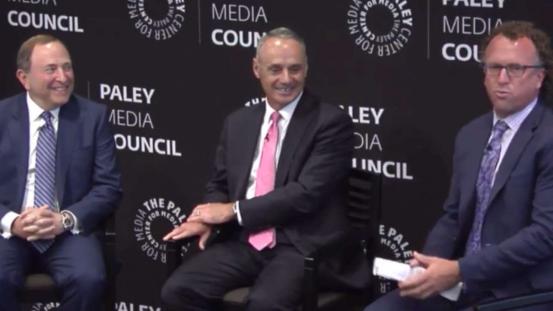
NEW YORK — Rob Manfred and Gary Bettman are Commissioners of the two longest-running professional sports leagues in North America, and they are also partners through the recent digital rights deal between Major League Baseball and the National Hockey League.
On Wednesday afternoon, the pair were together as speakers for the Paley Media Council’s luncheon at the Paley Center in Manhattan, moderated by Abe Madkour of the SportsBusiness Journal. They talked about the fast-changing media landscape, vision and execution, the MLB-NHL digital partnership and more.
On the pressures of being Commissioner:
RM: A single thing that hit me after I got elected — and it started in the selection process — you had to take some vision about what you want to do with the business. I think that that is a very challenging transition. I had a lot of good people [and] we had some simple things that we think are really important to business. No. 1 is youth. I’ve got kids, and the youth space is really competitive. We weren’t spending any, not just money — we weren’t paying any attention to what was going on with youth sports. And it’s probably our single biggest, most-focused initiative today. … Technology, because of what (MLBAM) was, because of its leadership position, because of the connection of technology to youth, it wasn’t hard to sort of figure out step two.
And I think the third one is the one that’s morphed over the first 18 months or so, internationalization of the game. When we started talking about it, baseball has some great pockets of strength — Japan, Korea, Taiwan, Latin America, obviously North America — but it doesn’t have the reach of some other sports globally, and we thought it was important to get on that in terms of the long-term growth of the game. As we’ve started to see technology develop and change, we’ve come to realize that with things like virtual reality, it’s not so much that you’re going to play in Australia on a regular basis — it’s too far for us, especially with our schedule — but you have to have a fan base, and there is a huge opportunity to have a fan base that can consume using that type of technology if you can jump-start some interest in those distant markets.
GB: I think it was Walter Isaacson who said, “Vision without execution is hallucination.” You built credibility by doing that and by achieving a level of success. To me, the thing that’s always been the most important thing is the game. Everything else you do — whether or not it’s any aspect of your business, it’s media connectivity, it’s grassroots programming, it’s filling your buildings, it’s marketing and promotions — if the game isn’t good, if you don’t have a competitive, entertaining, exciting game, you can market all you want, but that is not authentic. All of us need to maintain our authenticity. The games have to be perceived as having integrity, decided on their merits, and then skill is what is ultimately prevailing.
RM: The hardest thing, thinking about the future, is the game itself. It’s particularly hard in our sport because of the history and tradition. You’ve got to be really careful about what you do, because there are so many people who are bound up in the traditions of the game that you can’t …
continue reading in source mlb.mlb.com